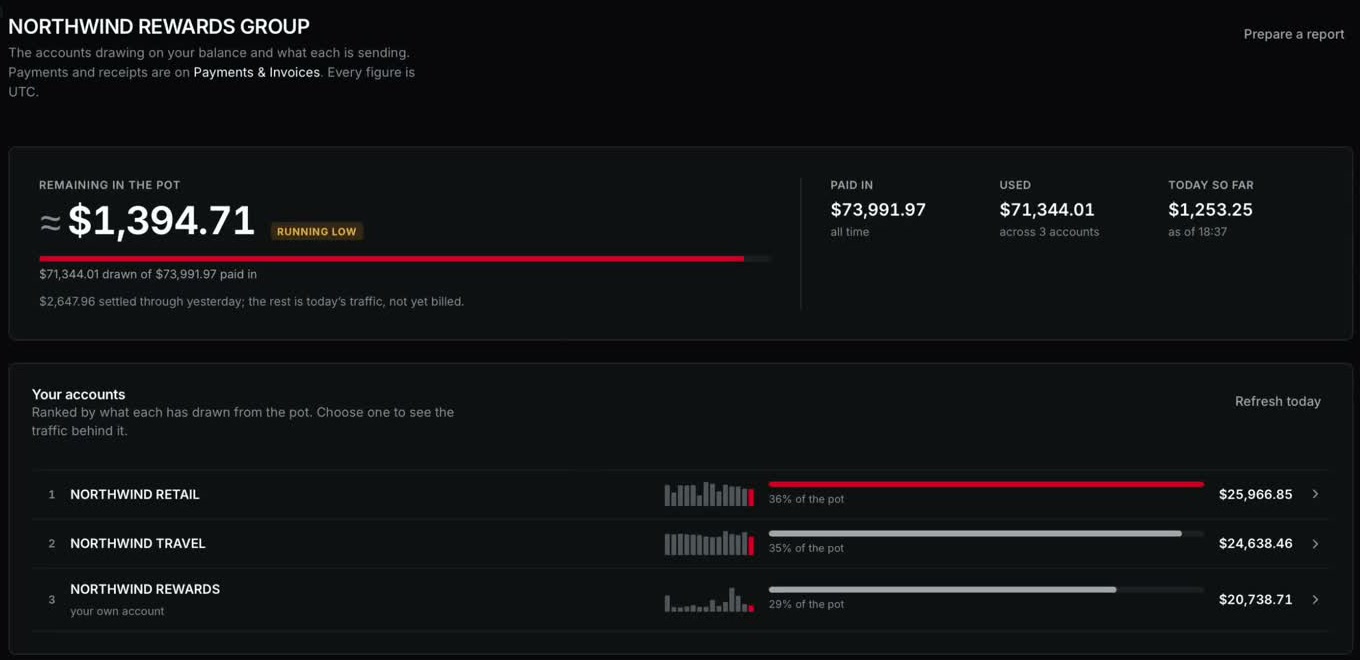
One balance for three brands' messaging, with finance serving itself
Three brands on Engage under one pot: usage priced daily from what was sent, a numbered receipt on every payment, one report across the group.

Every engagement starts with a goal the client has set: every taxpayer reached, one balance across a group's brands, the answer in front of a support agent before the question is finished. These are the systems we built toward those goals, what runs today, and where each one is going.
Three brands on Engage under one pot: usage priced daily from what was sent, a numbered receipt on every payment, one report across the group.

A sign in gateway inside the property tax module, carrying the department's authentication traffic since the day it went live.
Every event from the department's systems in one record its decision makers can act on, scheme communication across the department, and a barcode on every demand notice.
Models trained on the company's public material, with a data warehouse built alongside. A pilot, measured with the company.
A public website, live, and a Zoho CRM with leads, properties, owners and who in the firm may see what.
Clients are named only with their written permission. Figures appear only when a client has supplied them in writing.
Rewards and loyalty group, three brands
The group sends customer messaging for three brands. Each brand has its own sender identity and its own traffic, so each needs its own account. But the money is one pool: the group pays in once and expects every brand to draw from it, and expects a statement that explains, per brand, where the money went. Three separate accounts with three balances would have meant three payments, three receipts and adding up at month end.
The group is a live Engage customer. Usage is fetched and priced on schedule every day, receipts are issued as payments are recorded, and the same engineers who built the ledger run it.
The pot is now a standard part of Engage. Any group paying for several brands, and any aggregator reselling messaging to its own customers, gets the same ledger, the same receipts and the same report from the first day.
Municipal corporation, citizen authentication
The corporation's property tax platform handles payments, property mutations and file approvals for the whole city. Each of those actions has to be tied to the citizen performing it, which means a code sent to the citizen's phone and verified before the action goes through. The platform needed a service it could call for that, fast enough to sit inside a payment flow, and reliable enough that a failed code never blocks a tax payment.
The gateway runs as a container we host and monitor. The engineers who wrote it are the ones who answer when the platform's team reports a problem. It has carried the department's authentication traffic since it went live.
The gateway is a service the platform calls, so each new citizen action the corporation adds can use the same sign in step, and each new notice the same path. Nothing on the platform's side has to be rebuilt for the next module.
Municipal corporation, property tax operations
A property tax department runs on several systems, and each one records what it does: payments, mutations, approvals, notices, campaigns. Read one at a time they are logs. Read together they are the state of the department. The corporation wanted that whole picture, and it wanted its rebate, amnesty and deadline schemes to reach taxpayers through the channels the department already uses.
The aggregation runs continuously against the department's systems; scheme communication runs when the department announces one. Both are operated by the engineers who built them.
One clean record of the department is the ground for what comes next: models that read the whole department and flag what needs a decision before someone goes looking for it. That is the work our AI and data practice is built for.
Listed company, customer support
A listed company's support team answers questions whose answers already exist in the company's public material, spread across many places. The pilot tests whether models trained on that material can put the right answer in front of an agent faster than the agent can find it, and whether a warehouse built from the same data serves the rest of the company.
A pilot, measured with the company. Nothing about its results is published here until the company agrees to it.
The measure is simple: does the right answer reach the agent faster than the agent can find it. If it does, the same models and the same warehouse serve the rest of the company's questions, not only support's.
Commercial real estate brokerage
A Dubai brokerage sells and lets commercial property. Its leads, its properties and the owners behind them were tracked by the people who held them. The brokerage needed a public website first, then a CRM shaped around how a brokerage actually works: a lead, the property it is about, the owner of that property, and who in the firm may see what.
The website is live. The CRM's phase 1 was in development in the first half of 2026.
Phase 1 sets the records. The configuration is ready for the phases after it: automation, reporting, and messaging from the record through Engage, so a follow up starts from the lead and writes its result back.
Every system above points the same way: software that reads the whole operation, reaches people on the channel they answer, and acts from the record. Three directions we are building toward with every client.
Models trained on the customer's own data, fine tuned as corrections come in, measured against one job inside a workflow. Voice AI agents on Engage that answer and place calls.
WhatsApp, SMS, RCS, email and voice from one account, priced daily from what was sent, with one balance for a group of brands or an aggregator's customers.
Salesforce and Zoho shaped to how a company sells and serves, with a message starting from the record through Engage and writing its result back.
Tell us what you are setting out to do. We come back with a written scope and a price, show working software every week, and run the system after launch with the engineers who built it.
Or write to support@saasquirk.com. SAASQUIRK LLP, India.